Is a Car-free Lifestyle Possible in the City of Atlanta?
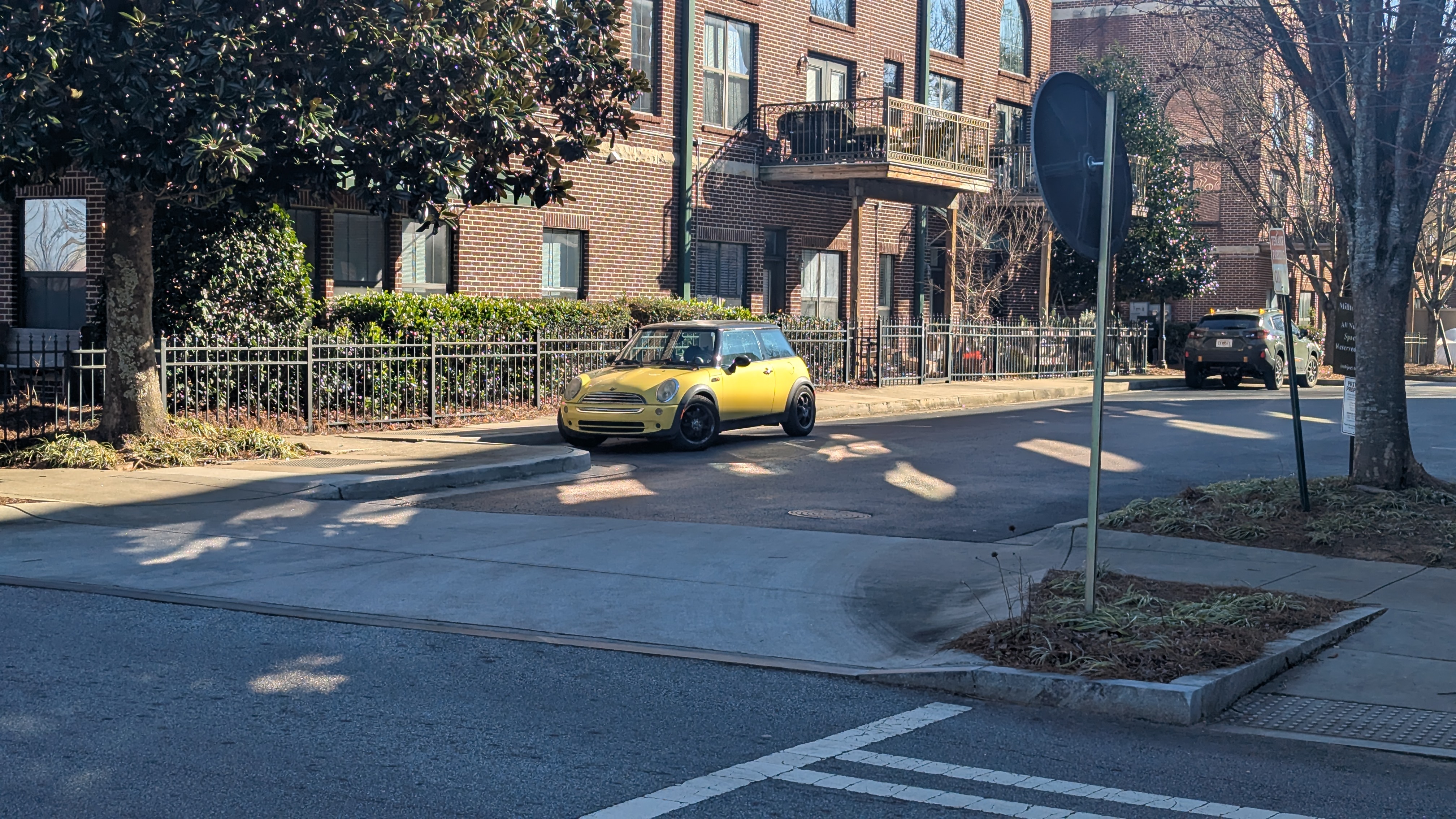
Atlanta’s Transportation Juxtaposition: The Yellow Mini Cooper Story
So let’s add a bit of context to my fascination with Atlanta and its transportation challenges. The photo of the yellow Mini Cooper will have much more significance as I share my journey of interests discovery.
Since about late 2024 I had been considering what it would mean for me to enter the electric vehicle industry and take part in the electrification of transportation as my career. I’ve always had a love for cars since I was a kid, and realized pretty early on that electric vehicles would make them even better being quieter and zero tailpipe emissions alternatives, something important to someone who struggled with year round allergies. I began considering, however, if the electrification of vehicles would repeat the same mistakes of past industrial revolutions. Could the “clean-tech revolution” avoid the pitfalls of unrestricted resource extraction that oppressed communities and left them in seemingly endless conflict and war? As I began researching it became pretty evident that those challenges of exploitation would exist for a while without the intervention of serious regulations and consequences for corporations.
The story could end there. “No hope in cleaning up the act of major corporations who will do anything to make shareholders happy.” But I couldn’t accept that. I imagined that for one, there has to be a better path forward to make the supply chain more humane and sustainable. Secondly, I challenged my love for cars by exploring how consumers could be less car-dependent. This led me down the wonderful rabbit hole of walkable cities. Automotive companies could do less damage if they extracted and produced less. The only way for that to happen though is if the people who “need” their vehicles didn’t need them at all. If people could get to their job, school, grocery store, or means of entertainment simply by walking or biking, fewer resources are extracted due to lower demand and more time and care could be spent in making the process humane.
“Problem solved! Let’s just redesign all of our cities to be walkable paradises with public transit to fill in for longer distances!” Ha ha! “This is America” as Childish Gambino would say. If I thought changing the business practices of corporations would be difficult, why would I think challenging politicians, NIMBYs, and lobbyists would be any easier? Well, the city of Atlanta, one of the most car-dependent cities in the nation, began to give me hope. I slowly began to watch a new identity for the city of Atlanta form around the bustling rail to trail development known as the Atlanta Beltline. The Atlanta Beltline is a 22 mile trail encircling the city of Atlanta, connected by parks, marketplaces, businesses, and housing. Envisioned by Georgia Tech alum Ryan Gravel, but championed and birthed through grassroots efforts of the local community, the Atlanta Beltline offers a peek into a walkable, pedestrian-independent, future for Atlanta, with promises of rail someday along the Beltline.
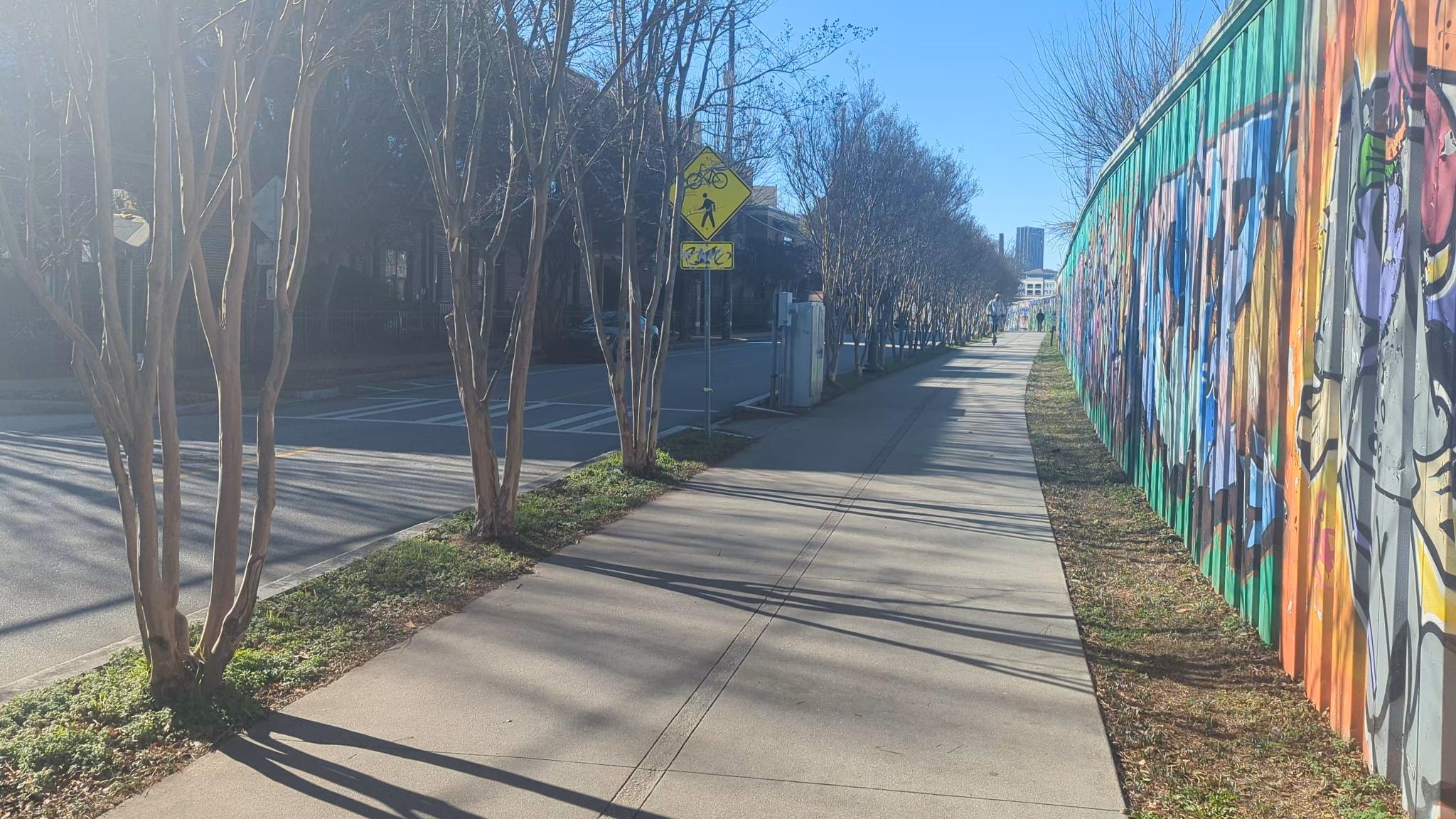
In my frequent visits to different sections of the Beltline, particularly near Ponce City Market on the eastside, I’ve fallen in love with what Atlanta is becoming. It’s clear that the Atlanta Beltline brings joy to those who use it daily for transportation and challenges the imagination to consider what car-free living could be like in the city. Okaayy, that last part might just be me. I want to know if it is possible to live like a New Yorker in the city of Atlanta, with hopes of moving to the Beltline very soon. So I’ve been exploring the most walkable areas of the city by foot and skateboard, getting a vibe for the life of a pedestrian in the city.
This lands us back to the yellow Mini Cooper. I took this picture while skateboarding along a section of the Beltline on my way to Krog Street Market where there were shipping containers with street art to my right and the beautiful brownstone homes pictured to my left. The yellow Mini Cooper in my mind captured the current juxtaposition of a city like Atlanta. While Atlanta feels as if it has always been a car-dependent city, it was once filled with streetcars taking people from place to place. Those were pushed out the way for the personal automobile and new lanes of highway every few years to “fix” Atlanta’s traffic problem. Now autonomous robotaxis from Waymo and the Beltline exists pointing towards another evolution of Atlanta’s modes of transit.
So with the vision laid out, let’s explore the possibilities and reality of living a car-free lifestyle in a city as car-dependent as Atlanta.
Fieldwork via Skateboard
Methodology: Kick, Push
I’m a novice at best when it comes to doing any urban planning work, but I took this as an opportunity to try doing what I’ve seen some of my favorite YouTubers in the space do (they’ll be listed in my inspiration section below). They simply walk around the city noting any interesting things along the way. Things like “How safe does it feel?”, “What are the people like?”, “How often do I see people?”, “Is there good food?”. My slight twist to this activity would be that I would zoom around a little bit via skateboard, as I did in my undergrad days as a CS (Computer Science) student at Georgia Southern University.
My overall methodology went something like this. I built a Notion page with a simple database where I could record my field notes for 3-4 locations over 2 days exploring the city by foot. I would make observations about options for housing, food, groceries, activities, parks, and access to things I personally cared about (diversity, rock climbing gyms, parks, EV charging access, etc.). The database table had three columns, the name of the place, a specific attraction to the area, and the Walk and Bike Score for that area.
Observations
The Walk and Bike Scores were key metrics to compare my own personal observations to. The Walk Score is a great metric to know how walkable a city may be. It uses information like proximity to grocery stores, shops, and other POIs, the amount of infrastructure dedicated to pedestrians and other factors to determine the walkability of a location on a scale from 0 to 100. The Walk Score methodology scores addresses 90 and above as a Walker’s Paradise, 70 and above Very Walkable, 50 and above *Somewhat Walkable, and below that location is considered Car-Dependent. The Bike Score follows a similar methodology but for bikes.
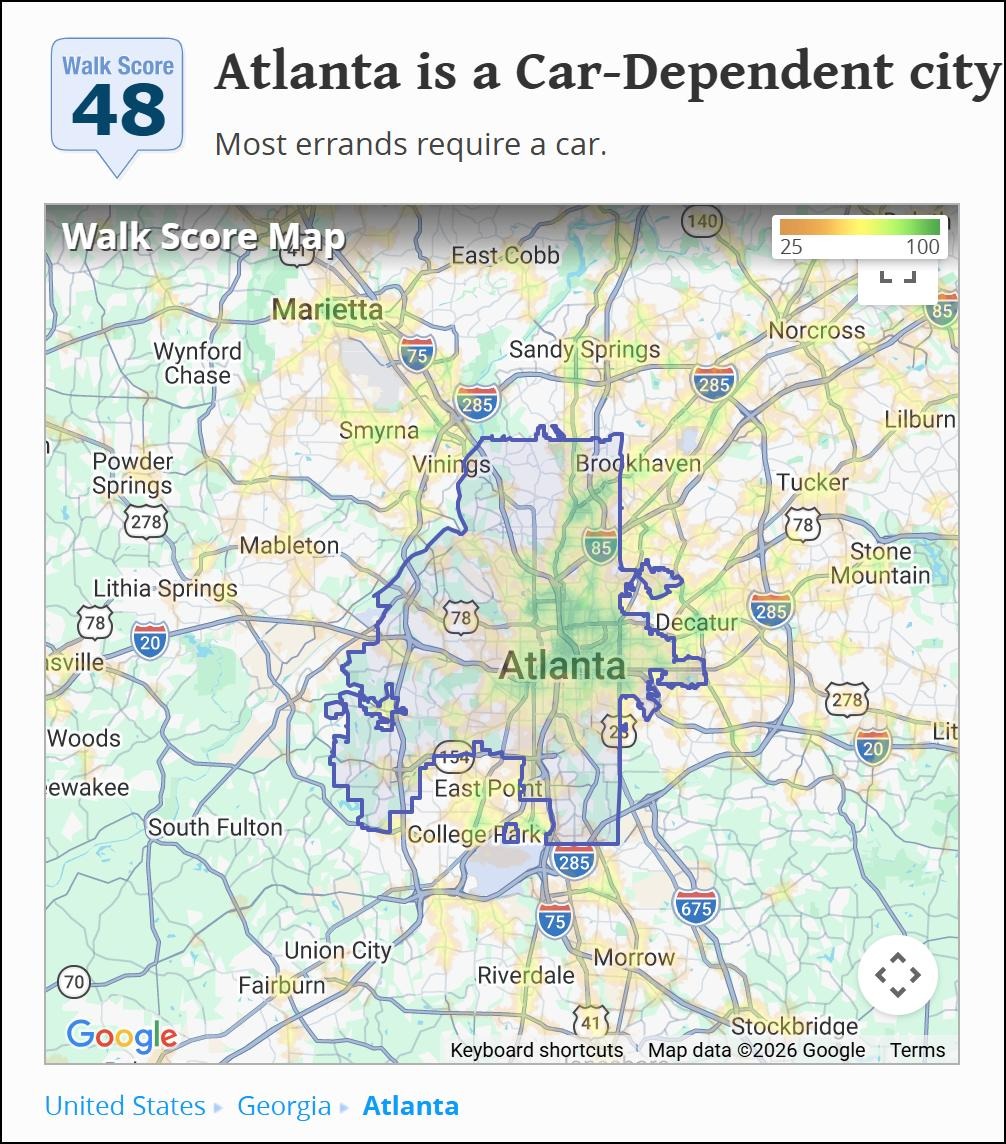
The locations I initially decided to explore over those two days of exploration needed to have a Walk Score of at least 70 and above, making them Very Walkable. When you initially search for the city of Atlanta on Walk Score’s , however, this would seem a bit challenging as it is considered Car-Dependent with an overall Walk Score of 48 and Bike Score of 42. Not a great look, but if you look closely you’ll see pockets of bright and dark green on the map, hinting at Atlanta’s walkable oases.
So the first four places I planned to visit were Ponce City Market (Old Fourth Ward), Midtown, Georgia Tech, and Atlantic Station. I would later visit some other locations with what I thought were promises of future walkability due to proximity to the Beltline or where quite walkable but just located further from the city center. Below is a peak at the Notion database that I developed with links to the Walk and Bike Score for each locaiton.
| City/Location | Attraction | Walk/Bike Score |
|---|---|---|
| Ponce City Market (Old Fourth Ward) | Eastside Beltline | 93/84 |
| Midtown | Proximity to Georgia Tech, but also popular area | 95/69 |
| Georgia Tech | Good for school access and the people there | 72/77 |
| Atlantic Station | Atlantic Station its self??? Microsoft? | 88/82 |
| Lee + White | Lee + White, a food court and commerce on the Westside Beltline; Rock climbing gym | 72/65 (up from 61/64 when I originally recorded) |
| Decatur | Old-town feel with bustling community and growth in sight | 60/69 |
| Reynoldstown | Access to Eastside Beltline near Krog St Market | 90/70 |
TODO: Get to the point already!
- Lively scene of pedestrian life near the beltline and walkable areas of Atlanta
- The evident need of some form of vehicular transportation to go beyond your 15 min city
- Driving around Atlanta can be a 20 min city by car on the best days, an hour in its worst
Why Sustainable Lifestyles in the Big City Matter
- Despite city dwellers having an overall lower carbon footprint than suburban dwellers
- American cities like Atlanta present interesting challenges
- They are car dependent and have a lot of people commuting to the city from nearby suburbs
- So are Atlanta natives sustainable while Atlanta commuters (there’s probably a specific word for this) are the issue?
- Should native Atlantans still try to be more sustainable regardless? Something like how New York City operates where most people use public transit rather than drive?
Resolving Atlanta’s Juxtaposition
What are some solutions to help citizens of cities like Atlanta be more sustainable?
- Investing in public transit to reduce car dependence
- New models of car ownership
- More ZipCar alternatives
- Community autonomous rideshare
- Micromobility
- Making the city more bikable as we have begun to make it more walkable
- Discuss funding mechanisms
Closing Thoughts
Venturing Further: What’s Next for [Blog Template]?
- Is renting more sustainable than home ownership?
- And the debate over ownership vs subscriptions
Inspiration: Helpful Resources
Here are some helpful resources I’ve gathered over the past couple years that have helped form my imagination around the Beltline and provide a deeper dive into everything revolving around its creation.
Books
- City on the Verge: Atlanta and the Fight for America’s Urban Future by Mark Pendergrast
- Where We Want to Live: Reclaiming Infrastructure for a New Generation of Cities by Ryan Gravel
Videos
- Walkable Cities But They Keep Getting More Affordable — Ray Delahnty, CityNerd
- SolarPunk Cities: Our Last Hope? — DamiLee
Events
- Life After Cars on 03/13/2026 @ Plaza Theater near Ponce City Market: A stop for Life After Cars book tour with authors Sarah Goodyear and Doug Gordon. Hosted by the bike advocacy group Propel ATL.
Enjoy Reading This Article?
Here are some more articles you might like to read next: